2026 Top Motorcycle Assembly Line Manufacturers?
The 2026 Motorcycle Assembly Line market deserves closer examination as motorcycle demand becomes more regional, automated, and quality-focused. The International Motorcycle Manufacturers Association has reported global powered two-wheeler sales above 60 million units in recent years. That scale increases pressure on manufacturers to improve takt time, traceability, worker safety, and model flexibility. Recent manufacturing outlooks from Deloitte and McKinsey also identify industrial automation, connected equipment, and predictive maintenance as major competitiveness factors.
A strong assembly line is not simply fast. It must control torque, alignment, welding accuracy, paint consistency, and end-of-line testing. Picture a digital torque tool recording every critical bolt, while a vision camera checks brake routing within seconds. These details separate dependable suppliers from attractive brochures. Taiichi Ohno, the Toyota Production System architect, stated, “Without standards, there can be no improvement.” His principle remains highly relevant to motorcycle production, especially when factories switch between scooters, commuter bikes, and premium models.
This overview examines leading Motorcycle Assembly Line manufacturers expected to influence the 2026 market. The comparison considers engineering experience, automation depth, modular design, installation support, energy efficiency, and verified customer performance. ISO 9001 certification helps, but certification alone proves little. Factory visits, acceptance-test records, and lifecycle service evidence matter more. No ranking is perfectly neutral. Regional labor costs, supplier networks, and product complexity can change the result. Some companies may appear less advanced because their automation is selective, not absent. That deserves reflection. A practical buyer should therefore judge complete production outcomes, not impressive equipment lists.
What Defines a Top Motorcycle Assembly Line Manufacturer in 2026
What Defines a Top Motorcycle Assembly Line Manufacturer in 2026
A top motorcycle assembly line manufacturer delivers repeatable quality, not impressive machinery alone. On the shop floor, this means stable torque control, accurate frame alignment, and traceable battery or fuel-system installation. Every critical fastening point should produce digital records. The International Federation of Robotics reported 541,302 industrial robots installed worldwide in 2023, a 10% annual increase. Automation is rising quickly, but skilled technicians still matter. Robots cannot judge every unusual vibration or imperfect weld.
Production flexibility also defines leadership in 2026. A strong manufacturer can switch between combustion, hybrid, and electric platforms without rebuilding the entire line. Modular fixtures, quick-change tooling, and software-based scheduling reduce downtime. The IEA’s Global EV Outlook shows continuing growth in electric two- and three-wheeler adoption, especially in emerging markets. However, forecasts can miss local charging limits and supply disruptions. A reliable manufacturer tests those weaknesses before promising capacity. No line is perfect.
Tips: Ask for measured OEE, first-pass yield, warranty-return data, and documented cycle-time studies. Check whether operators can trace one finished motorcycle back to components, torque readings, and inspection results. Request a pilot run, not only a presentation. A small trial often exposes feeder jams, unclear work instructions, and maintenance delays. Also examine training records. Technology without disciplined training becomes expensive decoration.
How Motorcycle Assembly Lines Are Designed and Integrated
In 2026, motorcycle assembly lines are designed around flexibility, traceability, and stable takt time. The global motorcycle market reached about USD 106.8 billion in 2023, according to IMARC Group’s industry report. That scale demands more than fast conveyor movement. It requires a controlled production system.
A typical line begins with frame preparation, followed by powertrain installation, wiring, braking, fluid filling, and final inspection. Engineers calculate takt time from demand, available labor, and equipment efficiency. The line may use torque-controlled tools, barcode tracking, and digital work instructions. Small details matter. A misplaced connector can stop testing later.
The International Energy Agency reported strong growth in electric two- and three-wheeler adoption, especially in Asian markets. Assembly layouts must therefore support both combustion and electric models. Battery handling needs separated zones, insulated tools, and monitored storage conditions. The design cannot treat electrification as a simple motor replacement.
In practical projects, modular fixtures reduce changeover time. Automated inspection improves repeatability, but it does not remove human judgment. A camera may detect a missing fastener. It may miss a poorly routed cable. I have found that line balancing looks convincing on paper, yet operators often reveal hidden delays. The weak point is usually a small handoff between stations. Data from the line should be reviewed daily, not only during annual audits. ISO 9001 principles support this discipline through documented processes and corrective actions. No layout is perfect. Floor space, worker fatigue, supplier variation, and maintenance access still require honest review.
Key Technologies Used in Modern Motorcycle Assembly Lines
Key Technologies Used in Modern Motorcycle Assembly Lines
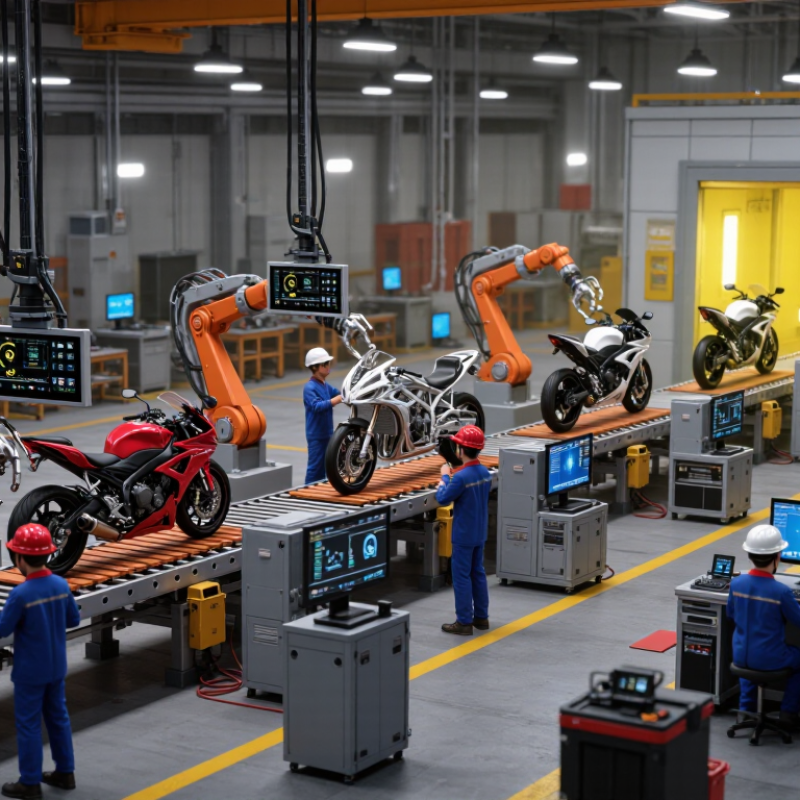
Modern motorcycle assembly lines combine robotics, machine vision, and connected production software. Robotic arms handle repetitive welding, painting, and component placement with steady accuracy. Machine vision checks frame alignment, fastener position, and surface defects under controlled lighting. Small errors become visible early. This reduces rework and protects rider safety.
Digital torque tools record the force applied to every critical fastener. Sensors can stop the line when a value falls outside the approved range. A manufacturing execution system links each workstation with serial numbers, test results, and operator checks. This creates a reliable traceability record. Automated guided vehicles also move parts between stations, reducing lifting injuries and unnecessary floor traffic.
End-of-line testing is more detailed than a simple engine start. Test benches measure braking response, electrical output, wheel balance, emissions performance, and vibration. Energy monitoring helps factories identify compressed-air leaks and inefficient equipment. However, technology does not remove every risk. A poorly calibrated sensor may approve a defective part. Human verification still matters, especially during software updates and unusual fault conditions. Assembly teams need practical training, not only screens and alarms. Continuous improvement sometimes begins with an uncomfortable question: are the machines detecting problems, or merely hiding them?
How to Evaluate Motorcycle Assembly Line Manufacturers
Evaluating motorcycle assembly line manufacturers requires more than comparing equipment prices. A reliable supplier should explain how its line meets your production volume, model range, and quality targets. Ask for documented results from similar projects. Check cycle time, line balance, defect rates, and equipment availability. Factory visits matter. Watch how operators handle tools, parts, and safety procedures during normal production.
Technical depth should appear in practical details. Review the layout, torque-control system, barcode traceability, testing stations, and spare-parts plan. Confirm whether the line supports future model changes without major reconstruction. Request a factory acceptance test with sample frames, engines, wiring, and finished motorcycles. The supplier should provide measurable acceptance criteria, training records, maintenance schedules, and clear responsibility for software updates. Vague promises are expensive.
References also need careful verification. Speak with production managers, not only sales contacts. Ask about delayed components, technical support response times, and unresolved failures. I once underestimated operator training because the machinery looked simple. That mistake caused inconsistent fastening during early trials. Do not repeat it. A strong manufacturer admits limitations and proposes controlled improvements. Review compliance documents, risk assessments, and local installation requirements before signing. Performance on paper is not production performance.
