How to Choose the Best Benches for Global Sourcing?
Choosing the best Benches for global sourcing requires more than comparing catalog prices. A successful purchase must balance comfort, durability, design, compliance, and landed cost. In practice, a bench that looks excellent in a showroom may fail after months of outdoor exposure. UV light, rain, salt air, and repeated loading reveal weaknesses quickly. Buyers need evidence, not attractive photographs.
Begin with intended use and measurable requirements. Record seat height, length, weight capacity, edge safety, and expected daily use. Match materials to climate. Powder-coated steel suits many public spaces, while treated wood requires clear maintenance planning. Recycled plastic can resist moisture, but its finish and thermal comfort deserve careful inspection. Request samples, test reports, material specifications, and production photographs. A factory audit can also confirm equipment, workmanship, packaging, and quality controls. Independent inspections before shipment add useful protection.
Global sourcing also depends on supplier reliability. Check reference projects, communication speed, warranty terms, spare-part support, and realistic lead times. Clarify packaging dimensions because freight charges can change the final price sharply. Confirm labeling and documentation with qualified local professionals for each destination. No checklist is perfect. I have seen small details, such as poorly protected corners, cause avoidable claims. A thoughtful sourcing process leaves room for that uncertainty. The best Benches are not simply inexpensive; they perform consistently, arrive safely, and remain practical for the people who use them.
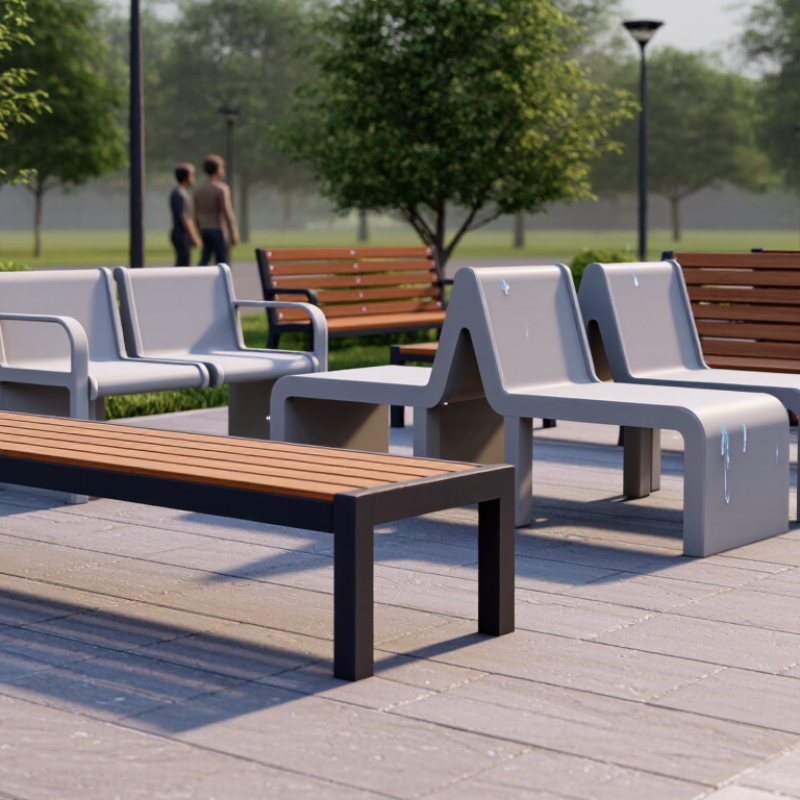
Define the Purpose and Setting for Your Benches
How to Choose the Best Benches for Global Sourcing?
Define the Purpose and Setting for Your Benches
Begin with the people and activities the bench must support. A waiting-area bench needs comfort, stability, and easy cleaning. A park bench needs weather resistance, drainage, and secure anchoring. School or transport settings may require rounded edges and stronger impact resistance. Do not choose from photographs alone. Ask suppliers for dimensions, weight limits, material specifications, and test reports.
The setting changes every sourcing decision. In humid coastal areas, untreated steel may develop corrosion quickly. Direct sunlight can also fade finishes or make dark surfaces uncomfortably hot. For indoor halls, smooth surfaces and concealed fixings can simplify daily cleaning. Measure doorways, lifts, paths, and installation spaces before approving a design. A beautiful bench is still a poor purchase if workers cannot move it safely.
I once reviewed a sample that looked solid but felt unstable on an uneven floor. That small detail changed the evaluation. Request a physical sample when possible, then inspect joints, edges, welds, and surface consistency. Test the bench in conditions close to its final location. Allow users of different heights and abilities to try it. I would also question whether a heavier model is truly better; transport and installation costs can quietly outweigh its strength. Keep records of inspections, supplier responses, and approved tolerances before placing a larger order.
How to Choose the Best Benches for Global Sourcing?
Define the Purpose and Setting for Your Benches
Typical seat-height targets vary by use: dining and waiting benches are generally designed around standard chair height, outdoor benches are often slightly lower, and changing-room benches commonly use a similar ergonomic range. Confirm local accessibility, safety, load, weather-resistance, and fire-performance requirements before finalizing specifications.
Compare Bench Materials, Designs, and Durability
Choosing the best benches for global sourcing starts with material performance. Solid hardwood offers warmth, repairability, and strong visual appeal. However, moisture changes can cause swelling, cracking, or joint movement. Use kiln-dried timber and inspect end grain before approval. Metal benches provide excellent structural strength, especially with welded frames and protective coatings. Yet, untreated steel may rust quickly in coastal warehouses. Aluminum resists corrosion, but it can dent under heavy impact.
Design affects both comfort and logistics. A bench with a slightly curved seat supports longer use than a flat plank. Rounded edges reduce sharp contact points and improve safety during handling. Slatted seats drain rainwater, while solid seats are easier to clean indoors. Check the underside carefully. Weak brackets often fail before the seat does. Knock-down designs reduce shipping volume, but extra fasteners create more assembly risks.
Durability should be verified, not assumed. Request load testing, surface-finish checks, and repeated assembly trials. A practical test might apply 150 kilograms for several hours, then inspect joints for movement. Test samples in heat, humidity, and cold storage when destinations vary. Powder coatings usually perform well, but poor preparation can cause peeling. This is where sourcing teams sometimes overtrust specifications. I have seen attractive samples develop loose screws after limited use. A stronger seat may still be a poor choice if replacement parts are unavailable locally. Check packaging too; crushed corners can turn a durable bench into a costly claim.
Evaluate Size, Comfort, Capacity, and Safety
Choosing benches for global sourcing starts with measurements, not attractive photos. Measure length, depth, and height against the intended room and user group. Leave clear walking space around each unit. A 120-centimeter bench may fit a catalog image but crowd a narrow reception area. Confirm packed dimensions too. Shipping cartons can complicate storage. I once underestimated door clearance on a sample order. That small mistake delayed installation.
Comfort depends on seat height, depth, edge shape, and surface firmness. Test a bench for at least ten minutes, if possible. Hard, sharp edges become obvious quickly. Ask suppliers for foam density, material composition, and moisture resistance. Capacity needs more than a simple weight number. Check the tested load, loading method, and whether it applies across the full seat. Reinforced joints and stable legs matter. A bench should not rock when pressure shifts. Comfort testing can remain subjective. Record who tested it and why.
For safety, review anti-tip features, fasteners, rounded corners, and floor protection. Request inspection reports, production samples, and clear quality tolerances. Compare the sample with the approved specification before shipment. Independent checks are useful when quantities are large. Confirm materials suit the climate, especially humid warehouses or dry interiors. Ask about maintenance and replacement parts. A low price can hide frequent repairs. Reconsider choices after real user feedback. Record complaints and changes after installation.
Review Global Suppliers, Certifications, and Production Standards
Choosing benches for global sourcing requires more than comparing prices and photographs. Review the supplier’s factory location, ownership, production capacity, and recent export experience. Ask for batch records, material specifications, inspection reports, and corrective-action evidence.
Certificates are clues. They are not proof.
The ISO Survey 2022 recorded more than 1.2 million ISO 9001 certificates worldwide, showing how widely quality systems are used. However, certification does not guarantee every bench meets the agreed specification. Verify the certificate number, scope, issuing body, and renewal date.
For wooden benches, request chain-of-custody evidence for responsibly sourced timber.
For metal frames, check corrosion testing, weld inspection, coating thickness, and load results.
Relevant regional standards, such as EN 581 or ASTM seating requirements, should match the destination market.
Production standards should also cover worker safety and environmental controls. The International Labour Organization estimates nearly three million work-related deaths annually, which makes factory safety records highly relevant during supplier evaluation.
Review machine guarding, protective equipment, emergency exits, chemical storage, and training logs. The OECD Due Diligence Guidance recommends risk-based checks throughout global supply chains, not only at the final factory.
An on-site audit is useful, but announced audits can hide weaknesses. Unannounced inspections offer stronger evidence, though they cost more and may disrupt production. Include independent pre-shipment inspections, moisture checks, carton-drop tests, and random sampling in the purchase agreement.
Small details matter. A perfect sample can still conceal inconsistent production.
Calculate Costs, Shipping, and Long-Term Value
A low unit price can hide expensive freight. For global bench sourcing, calculate total landed cost before comparing suppliers. Add product price, packaging, inland transport, ocean or air freight, insurance, duties, broker fees, and destination delivery. Request carton length, width, height, and gross weight. Multiply carton volume by quantity to estimate cubic meters. Compare quotes under the same delivery term, such as FOB or DDP. Ask for two freight scenarios. One slower. One faster. Seasonal surcharges and port congestion can change the result. Leave an 8% to 12% contingency.
Shipping design matters as much as the bench itself. A sturdy bench with oversized cartons may lose its margin in transit. Compare knock-down and assembled packing, but check assembly labor and damage risk. Use corner protection, moisture barriers, and clear carton labels. For a trial order, inspect random cartons and record scratches, loose joints, and missing hardware. Ask for load-test results and material moisture readings. These records make supplier claims easier to verify. Not every inspection catches everything.
Long-term value includes cleaning time, repairability, replacement parts, and expected service life. A cheaper surface that chips after one wet season may cost more than a durable finish. Estimate annual maintenance, then divide total cost by expected years of use. Include returns and disposal. Test one bench in a real location for 30 days. Track wobble, fading, comfort, and delivery damage. No forecast is perfect. That small test may challenge a polished spreadsheet.
How to Choose the Best Benches for Global Sourcing? - Calculate Costs, Shipping, and Long-Term Value
Planning comparison for a standard 1.8 m, three-seat outdoor bench | Bench Type | Typical Construction | Unit Weight
(kg) | Packed Volume
(m³/unit) | Factory Price
(USD/unit) | Packaging
(USD/unit) | Ocean Freight
(USD/unit) | Inland & Handling
(USD/unit) | Estimated Duty & Fees
(USD/unit) | Estimated Landed Cost
(USD/unit) | Expected Service Life
(years) | Annual Maintenance
(USD/unit) | Five-Year Ownership Cost
(USD/unit) | Five-Year Cost
per Seat/Year (USD) |
| Powder-Coated Steel | Galvanized steel frame with steel slats and outdoor powder coating | 32 | 0.18 | 82 | 8 | 24 | 14 | 10 | 138 | 8 | 9 | 183 | 12.20 |
| Solid Acacia Wood | Kiln-dried hardwood slats with a treated metal support frame | 38 | 0.22 | 118 | 12 | 38 | 18 | 16 | 202 | 10 | 14 | 272 | 18.13 |
| Recycled Plastic | High-density recycled plastic boards with a galvanized steel frame | 42 | 0.20 | 145 | 10 | 30 | 15 | 12 | 212 | 15 | 4 | 232 | 15.47 |
| Aluminum | Anodized or powder-coated aluminum frame with aluminum slats | 24 | 0.17 | 165 | 9 | 27 | 14 | 13 | 228 | 15 | 5 | 253 | 16.87 |
Costing assumptions
- All figures are planning estimates in USD for a 100-unit ocean shipment, excluding local sales tax, installation, and financing costs.
- Ocean freight assumes palletized cargo moving from an overseas factory to a destination port; actual rates vary by route, season, container utilization, and Incoterms.
- Estimated duty and fees use a simplified allowance of approximately 5%–8% of the product and logistics value. Confirm the correct HS code and tariff with a customs broker.
- Five-year ownership cost equals estimated landed cost plus five years of routine maintenance. It excludes vandalism, abnormal weather damage, and major site construction.
- Five-year cost per seat/year equals five-year ownership cost divided by three seats and five years.
