Superabrasive

Why Choose a Natural Gas Boiler for Global Buyers?

For global buyers, a Natural Gas Boiler can offer a practical balance between heating performance, fuel availability, and installation flexibility. The Energy Institute’s Statistical Review of World Energy 2024 reported that natural gas supplied about 22% of global primary energy consumption in 2023. This broad infrastructure base supports procurement in many industrial, commercial, and residential markets. However, availability differs sharply between regions.

Efficiency matters. The U.S. Department of Energy states that high-efficiency condensing gas boilers can achieve roughly 90% to 98% annual fuel utilization efficiency. In real installations, that performance depends on return-water temperature, controls, pipe insulation, and regular servicing. A well-adjusted boiler should respond quietly, maintain stable water temperatures, and avoid repeated short cycling. Small technical choices affect long-term operating costs.

The International Energy Agency’s World Energy Outlook 2024 indicates that natural gas demand remains significant during the energy transition, although future growth will vary by policy and market. This makes gas equipment relevant, but not universally optimal. Buyers must examine fuel prices, emissions rules, ventilation requirements, spare-parts access, and local technician expertise before selecting a system. Methane leakage also deserves attention; the IEA’s Global Methane Tracker 2024 identifies fossil-fuel operations as a major methane source. That concern cannot be ignored.

No boiler is perfect. A Natural Gas Boiler may reduce installation complexity today, yet create future compliance pressure. Careful lifecycle assessment, verified efficiency data, and realistic maintenance planning can help buyers choose with greater confidence.
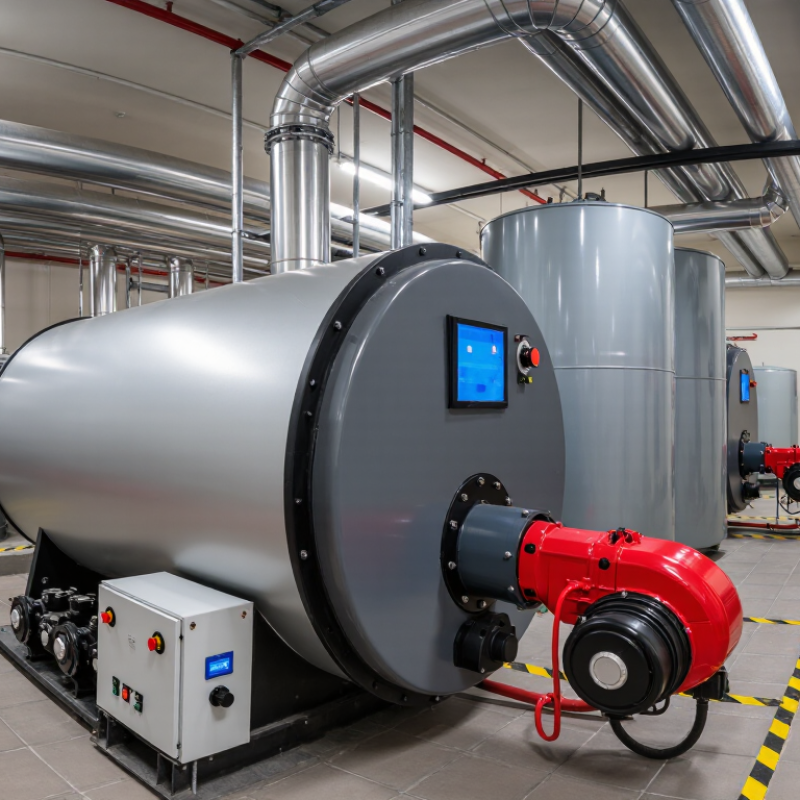
Why Choose a Natural Gas Boiler for Global Buyers?

What Is a Natural Gas Boiler and How Does It Work?

A natural gas boiler heats water by burning gas inside a controlled combustion chamber. The fuel enters a sealed burner, where an ignition system creates a stable flame. Heat then passes through a metal heat exchanger. The warmed water moves through pipes to radiators, underfloor loops, or a hot water cylinder. Simple in principle.

A thermostat measures room temperature and sends signals to the boiler controls. The system adjusts the burner and pump to match demand. In a condensing model, cooler return water helps recover heat from water vapor in the exhaust. This can improve efficiency. A flue safely releases remaining gases outdoors. Sensors monitor temperature, pressure, and flame quality during operation. Real buildings are less tidy.

From practical installation experience, correct sizing matters more than impressive product figures. An oversized boiler may start and stop repeatedly, wasting energy and increasing component wear. Global buyers should check local gas pressure, fuel quality, certification rules, and service availability before purchasing. A qualified technician should test combustion, seals, ventilation, and flue performance during commissioning. Annual inspection remains important, even when the boiler appears quiet and reliable. I would not treat efficiency ratings as guaranteed results. Poor pipe design, weak insulation, or incorrect controls can reduce actual performance. No system is perfect.

Why Do Global Buyers Choose Natural Gas Boilers?

Global buyers choose natural gas boilers because they combine familiar operation, rapid heating, and practical fuel access. In a cold warehouse, a properly sized unit can heat water quickly for radiators, showers, or process equipment. Existing gas pipelines also reduce installation disruption. For many facilities, replacing a boiler is easier than rebuilding the entire heating system.

Efficiency matters. The U.S. Department of Energy reports that high-efficiency condensing boilers can achieve approximately 90–98% annual fuel utilization efficiency. This can reduce fuel consumption when return-water temperatures stay low. The International Energy Agency’s World Energy Outlook 2023 also identifies natural gas as an important transition fuel in several energy systems, although its future depends on policy and methane control. Buyers often value stable combustion, compact equipment, and technicians who already understand gas systems.

The decision is not flawless. Gas prices can change sharply, as shown in the World Bank Commodity Markets Outlook. A low purchase price may become expensive during a long winter. Methane leakage and carbon regulations also require careful assessment. Buyers should verify local emissions rules, pipeline quality, ventilation design, and seasonal efficiency before ordering. A boiler room should feel controlled, not improvised. Small sizing errors matter.

What Factors Affect Boiler Efficiency and Operating Costs?

Why Choose a Natural Gas Boiler for Global Buyers?

What Factors Affect Boiler Efficiency and Operating Costs?

A natural gas boiler can provide steady heat, but its efficiency depends on more than the advertised rating. In field assessments, engineers often check gas pressure, fuel composition, altitude, and seasonal temperature. These details vary between countries. A boiler adjusted for sea level may perform poorly in a mountain facility. Incorrect combustion can increase fuel use, carbon monoxide risk, and maintenance needs.

Return-water temperature also matters. Lower temperatures usually help condensing boilers recover more heat from exhaust gases. However, oversized radiators, poor insulation, or badly balanced circuits can reduce this benefit. Clean heat-transfer surfaces improve performance, while scale and soot act like a blanket. Pump settings, burner modulation, control sensors, and ventilation influence daily operating costs. Installation quality is often underestimated. A highly efficient unit cannot compensate for leaking pipes or unsuitable flue design.

Tips: Compare seasonal efficiency, not only peak efficiency. Request combustion-test records and service intervals. Check local gas tariffs, spare-part access, and technician training before purchase. Keep a maintenance log with gas consumption, water temperature, and fault codes. Small records reveal expensive patterns. Do not trust perfect forecasts. Real buildings behave differently, and unexpected cycling may appear after installation. A site survey and local code review should guide final sizing. Proper commissioning is essential.

Why Choose a Natural Gas Boiler for Global Buyers? - What Factors Affect Boiler Efficiency and Operating Costs?

Practical reference data for evaluating efficiency, fuel use, operating cost, and installation conditions.

Evaluation Dimension Typical Data or Benchmark Effect on Efficiency and Operating Cost What Global Buyers Should Check
Boiler technology Condensing boilers commonly achieve approximately 90%–98% seasonal efficiency when correctly designed and operated. Non-condensing systems are often approximately 80%–88%. Higher seasonal efficiency reduces gas consumption for the same useful heat output. Condensing performance depends on recovering heat from water vapor in the flue gas. Confirm whether efficiency is reported as seasonal efficiency, fuel-utilization efficiency, or combustion efficiency, and whether the value is based on higher or lower heating value.
Return-water temperature Condensing operation is generally favored when return water is below approximately 55°C, with lower temperatures often improving condensation. Lower return-water temperatures allow more latent heat recovery and can improve seasonal efficiency by several percentage points compared with high-temperature operation. Check radiator or underfloor-heating design, system flow and return temperatures, and whether weather-compensated controls are included.
Load matching and modulation A typical commercial boiler may have a minimum-to-maximum modulation ratio ranging from about 1:4 to 1:10, depending on the equipment design. A wider modulation range reduces frequent on/off cycling, standby losses, thermal stress, and unnecessary fuel use during low-load periods. Compare minimum firing rate with the building’s minimum heat demand and assess whether multiple boilers can stage efficiently.
Seasonal operating profile Heating systems frequently operate below peak design load for most of the year; actual annual load depends on climate, occupancy, insulation, and hot-water demand. Selecting only for peak capacity can cause oversizing, lower part-load efficiency, more cycling, and higher maintenance costs. Use hourly or monthly load estimates rather than relying only on the maximum design heating load.
Natural gas energy content Natural gas commonly contains approximately 9.5–10.5 kWh of energy per cubic metre, although composition and local measurement conditions vary. The same boiler output can require different gas volumes in different markets because gas composition, pressure, temperature, and billing units differ. Confirm whether the supplier quotes gas consumption in m³/h, standard m³/h, Nm³/h, ft³/h, therms, or another unit.
Gas pressure and supply quality Required inlet pressure varies by boiler design; many systems use low-pressure gas supplies, while larger installations may require higher-pressure regulation. Insufficient or unstable pressure can reduce output, cause shutdowns, increase combustion problems, and raise service requirements. Verify local gas pressure, gas quality, regulator capacity, filtration, metering, and applicable installation codes.
Gas price and operating-cost sensitivity Fuel cost is calculated from gas consumption multiplied by the applicable local gas tariff, taxes, demand charges, and distribution fees. A higher-efficiency boiler reduces the amount of purchased gas, but the financial benefit depends on local gas prices and annual operating hours. Request a complete tariff structure and calculate costs using local currency, seasonal pricing, taxes, and fixed network charges.
Illustrative fuel-use calculation For 1,000 kWh of useful heat, at 95% efficiency and 10 kWh/m³ gas energy content: gas use ≈ 1,000 ÷ 0.95 ÷ 10 = 105.3 m³. At a hypothetical gas price of $0.50/m³, the fuel cost would be approximately $52.65 for 1,000 kWh of useful heat, excluding fixed charges and taxes. Replace the illustrative gas price and energy content with verified local tariff and utility data before making a purchasing decision.
Flue gas and chimney design Condensing flue gas can contain acidic condensate and may require corrosion-resistant flue materials, drainage, and suitable termination design. Incorrect flue sizing or poor condensate management can reduce reliability, create safety risks, and increase repair costs. Check flue length limits, material compatibility, condensate neutralization, ventilation requirements, and local approval procedures.
Maintenance and water quality Regular inspection, burner cleaning, combustion testing, and system-water treatment are important for maintaining rated performance. Scale, corrosion, blocked heat-transfer surfaces, and incorrect gas-to-air settings can increase fuel use and reduce equipment life. Evaluate local service availability, spare-parts access, water hardness, treatment requirements, and recommended maintenance intervals.
Emissions consideration Combustion of natural gas produces carbon dioxide; a commonly used approximate factor is about 1.9 kg CO₂ per cubic metre, varying with gas composition and accounting method. Higher efficiency lowers gas consumption and therefore generally reduces direct combustion emissions per unit of useful heat. Check local NOₓ limits, permitting rules, emissions-testing requirements, and the project’s carbon-reporting methodology.
Total cost of ownership Total ownership cost includes purchase, installation, gas connection, flue system, controls, electricity, maintenance, repairs, fuel, and eventual replacement. A lower purchase price may not produce the lowest lifetime cost if the boiler has poorer part-load performance, higher service needs, or limited spare-parts support. Compare projected lifetime fuel use and service costs over a defined period, commonly 10–15 years, using realistic local assumptions.
Data note: The figures are general engineering benchmarks and illustrative calculations, not quotations or guaranteed performance values. Actual results depend on boiler sizing, gas composition, climate, control strategy, system temperatures, installation quality, maintenance, and local tariffs.

How Should Buyers Compare Models, Standards, and Suppliers?

Why Choose a Natural Gas Boiler for Global Buyers?

Natural gas boilers can offer steady heat, compact installation, and reliable performance in many markets. However, buyers should compare models against actual building needs, not brochure claims. A small apartment may need a different output range than a factory or hotel. Check the calculated heat load, modulation ratio, seasonal efficiency, fuel pressure, and expected gas composition. A model designed for low altitude may perform poorly at higher elevations. This detail is easy to miss.

Tips: Request test reports, installation manuals, efficiency data, and emissions figures before negotiation. Confirm whether the model meets local safety codes and recognized standards, such as applicable European, North American, or regional requirements. Ask for evidence of certification, not only a logo on a sales sheet. Standards can differ between countries, and “international” does not always mean locally approved. Also compare spare-parts availability, technician training, warranty limits, and response times. A low purchase price may become expensive when a basic valve takes six weeks to replace.

Supplier evaluation requires practical evidence. Visit a production site when possible, or request recent inspection records and customer references from similar climates. Check quality-control procedures, pressure testing, combustion testing, and packaging for long-distance shipping. Honest suppliers should explain limitations clearly. No model is perfect. Even a well-tested boiler may need adjustment after installation, especially when water quality, gas pressure, or building insulation differs from laboratory conditions. Buyers should keep these uncertainties in the contract and require commissioning records.

Why Choose a Natural Gas Boiler for Global Buyers?

Comparing efficiency classes, standards, and supplier requirements

How to read the chart: Efficiency represents useful heat delivered from every 100 kWh of natural gas input. The 80%, 90%, and 95% values are representative benchmarks for conventional, standard condensing, and high-efficiency condensing boiler classes. To deliver 10,000 kWh of useful heat, these classes require approximately 12,500, 11,111, and 10,526 kWh of gas respectively.

Global buyers should verify the applicable local certification, seasonal-efficiency method, allowable NOx emissions, gas type and pressure, operating temperature, warranty coverage, spare-parts availability, and supplier testing documentation. EU Ecodesign Regulation (EU) No. 813/2013 and U.S. DOE AFUE requirements use different evaluation methods, so ratings should be compared only within the same standard.

Reference framework: European Commission Regulation (EU) No. 813/2013; U.S. Department of Energy residential boiler efficiency requirements. Values shown are technology-class benchmarks, not company or brand specifications.

What Are the Installation, Maintenance, and Safety Requirements?

Choosing a natural gas boiler can offer steady heating and efficient hot water for many properties. However, installation requirements differ across countries and local jurisdictions. Buyers should confirm gas standards, ventilation rules, flue design, and required permits before shipment. A licensed heating professional must size the boiler according to building heat loss, not floor area alone. Oversizing causes short cycling and unnecessary fuel use.

The installation area needs a stable base, adequate combustion air, and safe access for servicing. The flue must discharge combustion gases outside without obstructing windows or air intakes. Gas connections require approved materials, pressure testing, and leak checks. Condensing models also need a suitable drain for acidic condensate. That detail is often missed. In cold climates, exposed pipes may need insulation or freeze protection.

Maintenance should include annual combustion testing, burner inspection, heat exchanger cleaning, pressure checks, and condensate drain cleaning. Water quality matters because scale can reduce heat transfer and damage internal parts. A carbon monoxide alarm should be installed near sleeping areas, following local guidance. Users should never block vents or attempt gas repairs themselves. Keep service records, even when the boiler appears normal. Small warning signs, such as unusual noise, yellow flames, or repeated shutdowns, deserve prompt inspection. One practical weakness remains: maintenance schedules are sometimes treated as optional, especially in mild seasons. That mistake can become expensive and unsafe.

All search results